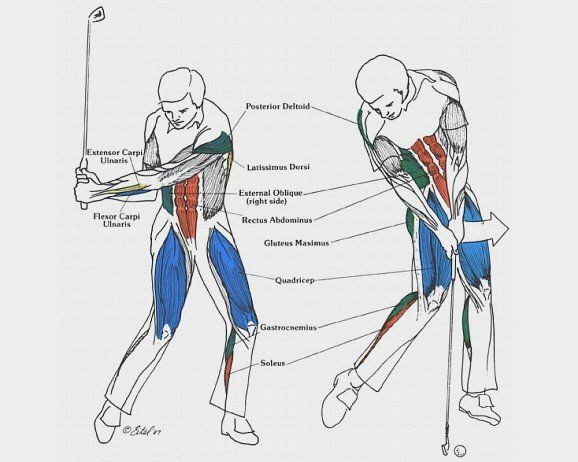
Golf and spring seem to go hand in hand. Watching Sergio Garcia win the Masters in epic fashion makes anyone who watched want to get off the couch and play right away. Because the weather is finally getting nicer, and the Masters Tournament just happened a few weeks ago, I feel like it’s a great time to talk about golf.
Tiger Woods, in his prime, could generate club head speeds of 125 mph in less than one third of second. Jason Day can go from 0-120 mph in two tenths of a second. In comparison, that is three times faster than the acceleration of the fastest Top Fuel drag car. For Tiger, his wrists flex more than a major league pitcher throwing a curveball. And to top it off, it takes forces of fifteen times his bodyweight to decelerate his swing. That is more force on his knees than an NFL running back making a cut to change directions. Rory McElroy is 5’9” and weighs 160 lbs. and can drive a ball over 300 yards consistently. Why, you might ask? His hips! Rory generates a rotational hip velocity of 720 degrees per second. Even the average golfer generates speeds of 350 degrees per second. (1)
A golf swing puts a huge amount of stress on an athlete’s knees, back, wrists, elbows, and shoulders. According to the American Orthopedic Society for Sports Medicine, over a two year period, 40% of amateur golfers will suffer either a traumatic or overuse injury while golfing. (2)
As a Strength and Conditioning Coach there are a number of different exercises, tools, and techniques we can use to improve your golf game and prevent those nagging injuries from occurring. Strength training, flexibility, and mobility are effective ways to make it happen. For example: to prevent back injuries, it is important to work on hip, shoulder, and wrist mobility. Golf requires training your body in all three planes of motion (sagittal, frontal, and transverse). Meaning forward/backward, side to side, and rotational. We always talk about core strength and its importance in everyday life and athletics and it’s no different in golf. In fact, it is one of the most important aspects of improving your golf game!
One way we accomplish this is by using the TRX suspension trainer and the RIP trainer. They are excellent ways to train all three planes of motion and work on mobility. A rotational exercise, like a mid-strike on the RIP trainer, is an excellent way of training your core through rotation. A TRX suspension trainer exercise, like a hip hinge or t-spine rotational, can increase mobility in your hips and shoulders. Traditional strength training is also necessary. Increasing strength and power in your upper and lower body is important in golf, just like any other sport. However, there is a reason one of the best golfers in the world is 5’9” and weighs 160 lbs. and consistently hits the ball 300 yards.
A golf swing is one of the most physically demanding movements in all of sports, which is why Tiger Woods isn’t playing golf right now. Almost every major muscle is used during one singular movement lasting about a second. Make sure your body is prepared to handle every swing this season. If you do, you will be looking at an improved game and healthier body.